Monday, August 21, 2006

Lost Art of Loving God, Part Four

A friend and fellow pastor once developed a list of Bible study suggestions geared toward lay people and those new to studying God’s word. I was impressed; The suggestions were basic, but helpful. I was impressed because I think sometimes pastors, in an effort to impress, fail to outline the fundamentals.

I have merged his suggestions with my own, and so I tend to call this the “Ken & Phil List.”
These are suggestions rather than God given rules. However, I think you might find some of them helpful.

Suggestions Bible Study & Meditation on God’s Word
PART ONE


1. Put consistency before quantity. Better 10 minutes a day than an hour “hit and miss.”

2. Find a time that is conducive to reading and prayer. You want to choose a time when you are alert, but also a time when you are least likely to have other concerns pulling on you.

3. Find a place that is conducive to reading and prayer as well. Mentally stake out this space as a place of daily reading and prayer.

4. Before you open the Bible, pray for insight & teachable spirit.

5. Have a “flexible plan” for what you will read. A plan is very important, as is some the flexibility to break out of your normal pattern here and there.

6. Many like to read through the Bible cover to cover, but this is not always the best approach. What will really help you grow? Consider starting with the Gospels, Romans, or Psalms.

7. As stated in part two of this series, find a friend who will keep you accountable to your plan. (Don’t underestimate the value of this!)

8. Bring your own Bible to church, especially if your church prints the Bible verses in the bulletin. It is helpful to get a “feel” for where things are located in your Bible, and a “feel” for the surrounding context.


9. Because the church was (and is) God’s idea, don’t feel guilty utilizing its resources. Consider making the sermon a springboard for what you read in the Bible one or two days of the week.

10. Use a notebook to record thoughts about what you read. You don’t have to be a writer, and you don’t have to write much, but consider C.S. Lewis’ words, “Writing takes the fuzz of our thinking.” It also helps us better retain what we have learned.

TO BE CONTINUED

Saturday, August 19, 2006

Lost Art of Loving God, Part Three: Meditation

Have you ever wondered how Joseph or Abraham lived a godly life without 66 books of the Bible to read through in a year?

The answer is found in this truth: We do not grow spiritually through reading God's word. We grow through meditating on God's word - and, one might add, on God's character and promises found there. Furthermore, God never says to simply "read" -- He tells us to meditate on what we read:


Psalm 1:1-3, emphasis added:

1
Blessed is the man who does not walk in the counsel of the wicked or stand in the way of sinners or sit in the seat of mockers.

2 But his delight is in the law of the LORD, and on his law he meditates day and night.

3 He is like a tree planted by streams of water, which yields its fruit in season and whose leaf does not wither. Whatever he does prospers.


This is not merely semantics. I think people are often discouraged because they read a chapter of the Bible each day, or a few chapters a day, yet don't find this rewarding - especially if they have read the Bible in the past and its pages are familiar. But to meditate on God's word implies pondering a passage's implications; it implies praying, repenting, changing direction in our heart, setting new goals, offering praise, and numerous other applications of the passage we read. It means, I think, reading slowly and thoughtfully. It means turning the passage over in our mind throughout the day, not merely reading it and hoping for the best.

Abraham and Joseph thought long and hard about God's promises. They lived not perfect, but certainly significant, lives of godliness. We have even more promises contained in God's word. Should we simply read them, or meditate on them?

Friday, August 18, 2006

Lost Art of Loving God, Part Two: Find a Friend!


For a long time, I thought of Bible reading as a pretty individualistic routine. After all, I’m not going to ask someone to come to my house and read the Bible to me. This is between me and God… Right?

Well…

One of the best suggestions I can give for maintaining regularity in Bible reading and prayer is simply this: find a friend.

Meeting regularly with a friend to discuss your personal concerns, and to commit to praying for each other, will do three important things to your devotional life. First, it will keep you focused. Second, it will keep you praying. Third, it will keep you from focusing too much on yourself.

Over the past few years, I’ve also discovered the tremendous benefit of friendship in relation to Bible reading. If you have trouble being consistent in your Bible study, here is one of the best suggestions I can offer. Find a friend and commit to reading through the same section of the Bible (such as Psalms, one of the Gospels, Romans). Agree on a pace, such as one chapter per day. Then, keep each other accountable.

I started doing this with a friend a year ago. We’re currently reading through the Psalms. And we have a simple agreement: email the other person each day. In that email, we can simply say “I read Psalm 31 today” or we can share some thoughts from it. Most days, we are sharing our thoughts – and usually in a pretty brief manner. So, technology can be your friend too!

Some might think, why find a friend when I can have devotions with my family? No argument with that, but many people find they need extra fuel in order to best serve their family. Plus, someone out there needs a friend – it might be you. Even if your devotional house is in order, you can help someone else.

Some of you might say, “I have no friends.” Then here’s another thing you can do, especially if you really want to act like a Christian. Take a Bible and head to the nearest nursing home. These folks have bodies that are breaking down, like yours will one day soon, and many of them would love to be able to read the Bible but can’t. So read it to them. Start with Psalms.

By the way, when I’m really old, or if I end up in the hospital, I would appreciate it if you would do this for me. Then I really will need someone to come to my house and read the Bible to me!

Thursday, August 17, 2006

The Lost Art of Loving God, Part One

“Spiritual disciplines” are those things we do to add discipline and direction to our spiritual life. Usually Bible study and prayer come to mind, and rightly so: these are two broad categories that describe our hearing from God and our speaking to God. However, if you’ve read a good book on the subject (such as The Bible), you know that other practices are described as disciplines too – healthy habits of worship, fellowship, service, and (gulp) fasting.

Basically, our spiritual life can be undisciplined or disciplined; haphazard or intentional; careless or thoughtful. I am convinced that one who loves God cannot be satisfied with “little visits with God” that are squeezed into an already full life. One who loves God will wish to know Him and serve Him, and will quickly realize that this does not happen without demanding something of ourselves and our time.

Paul said it this way: “Train yourself to be godly. For physical training is of some benefit, but godliness has value for all things, holding promise for both the present life and the life to come” (1 Timothy 4:7-8).

Over the coming days, I am going to discuss spiritual disciplines. I find that people are often frustrated with themselves, or uncertain how to proceed, in this area—specifically in the area of what we call “personal devotions.” If you fall into this category, please check in. My plan is to both reflect on the topic and to provide specific suggestions concerning Bible study, prayer, and thinking deeply about our God.

Now, let’s see if I’m disciplined enough to really do it...

Sunday, August 13, 2006

Wayward Sheep


A few days ago I wrote about Psalm 23 in "The Godfather, God the Father, and Psalm 23." (Scroll down to read.) In that post, I argued that this is not your momma's psalm - while it is a psalm of comfort, it's not a psalm that says "everything will be okay." Rather, its message is, "Everything is not be okay...yet. But if the Lord is your shepherd, you're in good hands."

I bring this up because I found the following comment on a political site today. The topic was finding comfort from Psalm 23 in times of terrorism, presumably with its words "I will fear no evil."

"I'd like to note that while I am not particularly religious, I consider the 23rd Psalm one of the greatest pieces of literature of western civilization and also one of the greatest comforts in hard times even for an unrepentant sinner such as myself. Hat tip to David, or whoever wrote that." (Jules Crittenden, referring to his essay Psalm 9-11: I Will Fear No Evil.)

Hmm. It seems rather presumpuous to praise the shepherd psalm in one breath and in the next to admit, "I will have nothing to do with the Shepherd."

Unless, perhaps, the writer is one of God's lost sheep?

Saturday, August 12, 2006

Recommended: Reformissionary

One of the best ministry blogs I've run across is "Reformissionary," by Pastor Steve McCoy. I encourage you to visit at http://www.stevekmccoy.com

Pastor McCoy has good thoughts, quotations, and links related to reformissional ministry. "Reformission" (a buzzword these days) seems to refer to the more orthodox versions of emerging church ministry, and in particular the church assuming a missionary stance to its surrounding community.

If you like photography, you'll enjoy his site too. In fact, it's one of the big draws for me.

Check it out!

* * *

UPDATE: Here's a quote from Mark Driscoll that defines "reformission." Mark Driscoll is the pastor of Mars Hill Church in Seattle, and as far as I can tell is the one who coined the term.

"Traditional churches have either leaned toward being fundamentalist and separated from culture, which has led to legalism and irrelevance; or they have leaned toward being liberally synchronized with culture, which leads to compromise and irrelevance. Either way, many traditional churches are irrelevant, whether they lean to the Left or the Right theologically and politically. Most contemporary churches are not very theological beyond a few evangelical basics, because they are guided more by pragmatism and programming than theology. At Mars Hill Church, we are driven by Reformed theological convictions and emerging missional methods. I like to say we are theologically conservative and culturally liberal.”

Thursday, August 10, 2006

The Godfather, God the Father, and Psalm 23


Near the end of The Godfather, Michael (played by Al Pacino) recites baptismal vows as he becomes “Godfather” to his niece. While he mouths words of peace inside the church, his enemies die violent deaths outside the church. Thus, as Michael promises to “renounce Satan and all his works,” his henchmen mow down Moe and Don in acts of family vengeance.

I don’t know if The Godfather was first, but this cinematic device has certainly been repeated since. Was it Schindler’s List or another film that showed a sniper taking shots while reciting Psalm 23? The point made is that the lofty hopes of Scripture do not translate so neatly into the real world. (Incidentally, that’s the overall point of The Godfather; Michael intends to keep out of the “family business,” but cannot. His father, famously portrayed by Marlon Brando, gives a dying speech to Michael to express his regret over this; yet Michael ultimately accepts and even embraces that he must follow in his father’s footsteps.)

I thought about these cinematic juxtapositions of Scripture and violence today as I read Psalm 23. While reading this famous psalm of comfort, cable news detailed the large terrorist plot that was reported today. This is the most violence that has been discussed on television since, well, yesterday.

So the question is, do the lofty ambitions of Psalm 23 fit into our violent world?

A psalm of David.
The LORD is my shepherd, I shall not be in want.
He makes me lie down in green pastures, he leads me beside quiet waters,
he restores my soul. He guides me in paths of righteousness for his name's sake.
Even though I walk through the valley of the shadow of death, I will fear no evil, for you are with me; your rod and your staff, they comfort me.
You prepare a table before me in the presence of my enemies. You anoint my head with oil; my cup overflows.
Surely goodness and love will follow me all the days of my life, and I will dwell in the house of the LORD forever.


If Psalm 23 were merely wishful thinking or sentimentalism, the answer would have to be “no.” But here are some clues that it is not:

“He restores my soul.” … “Even though I walk through the valley of the shadow of death…” This psalm is concerned with stilling the conflict within us, not every conflict that rages outside us.

“He guides me in paths of righteousness…” This psalm is about learning righteousness, not obtaining consumerist comforts.

“…for his name’s sake.” The promises here are driven by God’s jealousy over his glory, not his desire to glorify us. (Although we sure do benefit, don’t we?)

“...in the presence of my enemies.” Enemies? This is sounding less sentimental all the time!

I could go on. The point is that this psalm deserves a second look. Don’t get me wrong, it is indeed comforting! It is comforting enough to work in a violent world just as much as in a peaceful one, for it moves us not toward retirement but to eternity. We might say that it is a psalm about God’s fathering rather than God’s mothering…though we often assume the reverse.

In The Godfather, Michael executes vengeance on his enemies. In Psalm 23, God the Father leads us in paths of righteousness and ultimately prepares a table for us in the presence of our enemies. Can we find in this psalm what we need to find peace in a violent world? Have we tried?

Sunday, August 06, 2006

News Roundup


Since many folks read this blog with their morning coffee rather than reading the newspaper, I thought it important to share with you a few items found in today's Morning Call.


National News
One headline reads "Friends of accused serial killer surprised." I would hope so! You certainly don't want to ever find yourself saying, "Why, yes, he is a friend of mine. A serial killer? Of course, I've known that for quite some time now!"

Entertainment
In a story concerning marketing Oliver Stone's new movie World Trade Center to teenagers, a 14-year-old girl is quoted. Her words reveal much about teenagers and the media. Can you see the irony here? "I remember back in 2001 when it happened on the news. I kept thinking, 'This isn't real, it's just one of those disaster movies.' This movie made me feel Sept. 11 was real for the first time."

Religion & Society
Then there's this headline: "Church tells Katrina family it's time for them to leave." This is an interesting story about a church that took in a Katrina victim and her children, after her plight had been described on Oprah. She was given a home to live in, free of charge, for a year. Now she is getting the eviction notice, and she's more distressed and angry than, say, thankful.

It's an interesting story because, on the one hand, it is true that a year is not as long as it seems to get back on your feet (especially if you have children). Also, this reminds us that those displaced by Katrina are still trying to find their way. One University of Texas professor says, "In Houston, the welcome mat is not only longer out, it's been put through the shredder."

On the other hand, this woman was given a great place to live for a year. After one month, she quit her job. Says the United Church of Christ minister Michelle McNamara, who will now receive her parsonage back, "I'm certain there are thousands of people in Illinois or anywhere...who, if they were given the opportunity to live rent-free in a home the entire year and have their needs met, would seize the opportunity and change their life in such a way that the future would be radically different." She is careful to point out that hosting the family has been an "incredible blessing," that her "heart is breaking" over this, and that the church has put her needs first for an entire year. Maybe they are still putting her needs first...

That's the news! Have a great day.

Friday, August 04, 2006

Memo to Mel: We're Better than You!

Actor and filmmaker Mel Gibson may never work in Hollywood again. After lashing out at a police officer with some hateful anti-Jewish comments, a boycott has been called on all things Mel. One site even explains how to most effectively ban Mel.

Now, I have to admit that I heard this story through the rather large grapevine and didn't research what he actually said until today. But as the coverage of this story magnified, and as the Mel Ban intensified, something didn't sit right with me.

It is quite ironic that Mel Gibson would be banned from Hollywood for sinning. Hollywood loves to sin, and to do it on a grand scale. If you've seen any trailer for the move "You, Me, and Dupree" you know this. Or, if you've seen any other PG-13 movie released in the past decade. Yet Owen Wilson and company are not banned from Hollywood -- their widely distributed sins are considered playful, funny, and harmless.

So I thought to myself, this is the problem with "political correctness." Much like a secular religion, and a fundamentalist one at that, political correctness allows people to feel smug as they judge others for those sins that are not socially acceptable...while engaging in countless others that are. How different is this from the fundamentalist preacher who wails against homosexuality but not divorce, who condemns Democrat sins but not Republican ones, who says "no rock music" but doesn't mind Frank Sinatra's "I Did it My Way," who condemns smoking but engages in gluttony?

The public stoning of Mel Gibson may be justified, for he has sinned. Sins against God deserve death, the Bible says. But the question is, why are so many eager to cast the first stone?

Wednesday, August 02, 2006

Boys Will Be Men


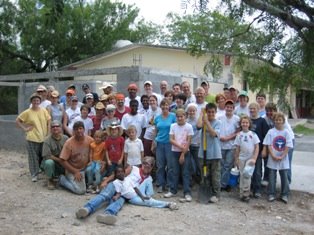
From July 22-29 I was part of a missions team that travelled to Reynosa, Mexico to work with Isaiah 55 Deaf Ministries. Their website, which describes their priorities and vision, is here. During the week, there were 62 people from various churches who took part in the work along with the staff of Isaiah 55.

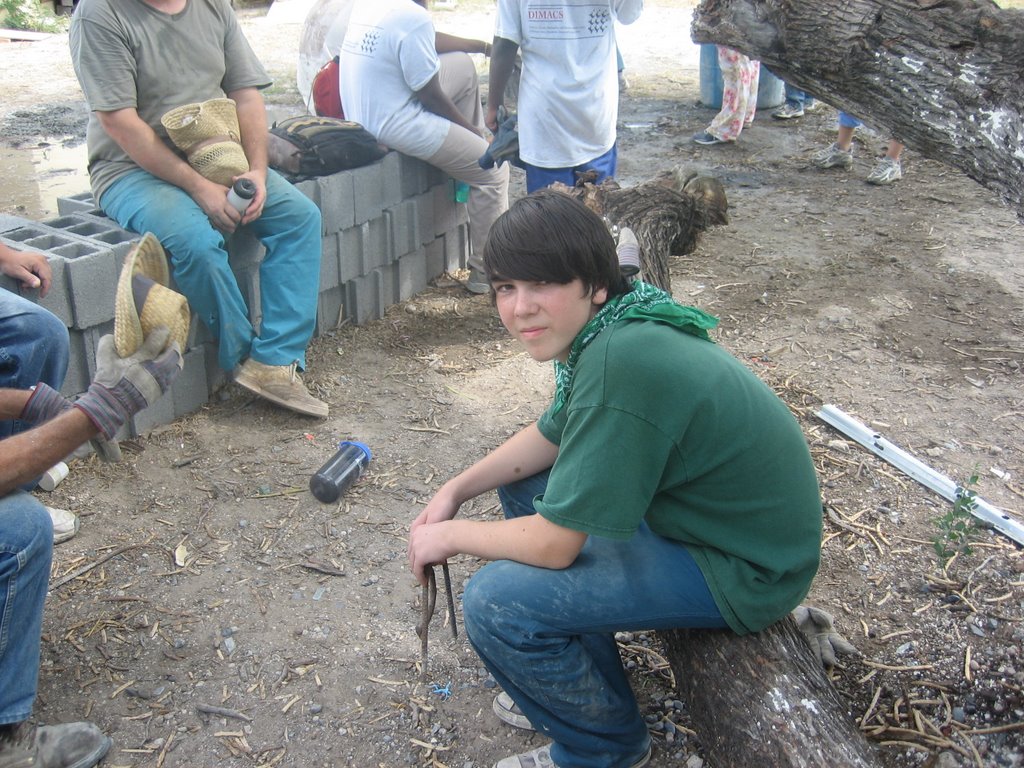
Although we offered a Vacation Bible School to children, I spent most of my time with the construction crews, improving and/or building schools (including a school for deaf children that will be operated by Isaiah 55). It was hot, hard work, the kind that dirties and destroys your clothes. Meanwhile, our attitudes were sustained by prayer and evening worship.

Many children came on this trip - more than they've ever had, in fact. Not just teens, but younger children as well. And what most impressed me on this trip was how hard and how well they worked. These kids were shoveling gravel and sand to mix concrete, digging a drainage ditch, cleaning up after the adults -- and they always asked for more work, not less.

After the trip, one of the teens commented about what he learned about himself: "I learned that I can work REALLY HARD," he wrote.

Throughout the week I found myself thinking, I wish that I had this opportunity...this attitude...this experience as a kid. Whether they realized it or not, the work instilled in these kids confidence and righteousness.

Wait a minute. Righteousness?

Yes.

To work hard, to grow into a man who can protect, provide, and use his hands, is a godly quality. Hear what the Apostle Paul wrote to some Christians who tended to be lazy and selfish:

"Now we command you, brothers, in the name of our Lord Jesus Christ, that you keep away from any brother who is walking in idleness and not in accord with the tradition that you received from us.
For you yourselves know how you ought to imitate us, because we were not idle when we were with you, nor did we eat anyone's bread without paying for it, but with toil and labor we worked night and day, that we might not be a burden to any of you. It was not because we do not have that right, but to give you in ourselves an example to imitate. For even when we were with you, we would give you this command: If anyone is not willing to work, let him not eat. " (2 Thessalonians 3)

This past week, cleanliness was not next to godliness. But sweatiness was!


Sunday, July 30, 2006

From Darkness to Light

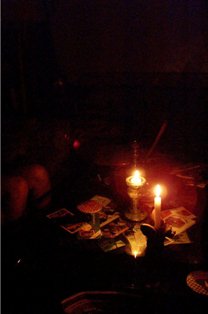
While I was away, St. Louis experienced a major power failure. One person who found himself blacked out was Jim Armbrecht, who wrote the following "reflection."

The Second Coming of Electricity


Life without electricity was a shadow of our former life. In a hot, dark room, we crouched around the battery-operated radio with poor reception, listening for news. It was hard to see the dial by the flickering light of the candles lined up on the table. Outside the neighbor’s generator whined. Occasionally a hot breeze would come through the open window. The candles would flicker in the air casting grotesque shadows on the walls. The only relief was a cold soda from the ice cooler. Outside the street was totally dark. Life without electricity was not life as it was meant to be.

Without a warning, it returned! Bright light filled the room, the whole house! The refrigerator kicked on, the air conditioning whined, the telephone messages started to play. Light switches that were formerly dead now provided light on call. Outside, houses were now lit again up and down the street. Someone set off firecrackers in celebration.

Suddenly, our former efforts, as well meaning as they were, now seemed puny. The candles on the table, once so important, were now insignificant as they were bathed in the strong brilliance of the room lights. The scratchy radio was forgotten as we gathered around the big screen TV listening to the latest news. The window with its hot breeze was quickly shut to make way for the air conditioning. The contents of the ice cooler were quickly moved to the refrigerator. This is the way things weresupposed to work. This is the way things were meant to be. For a time that seemed like an eternity there was no electricity, but now it had come back again.

- Jim Armbrecht

Friday, July 21, 2006

Break Room

Readers,

Thank you for visiting the site!

I will be away from the computer for about 10 days beginning Saturday, July 22. I look forward to returning at the start of August. Till then, I invite you to visit the sites linked from this one, or explore the archives here.

Till then!

Ken