Friday, March 31, 2006

Da Vinci Jesus


I have begun a new blog entitled "Da Vinci Jesus." This new blog, which will always be linked from this side (notice the options to the right), will focus on issues related to the historical Jesus. It will not change the content of this site, though occasionally there may be overlap.

The Da Vinci Code has been the most popular book of the past three years. It has sold 40 million copies, is about to be released as a hit movie starring Tom Hanks, and has made extraordinary claims about Jesus Christ - not to mention Mary Magdalene.

Da Vinci Jesus will examine all aspects of what scholars call "the historical Jesus." In my opinion, these issues are fundamental to all Christians. Our faith needs to be strengthened, and our witness sharpened, on the issues of the day - and this is an issue that isn't going away anytime soon.

In bite size pieces, the new blog will seek to help you in this regard. I hope you will visit!

Thursday, March 30, 2006

The Big Dance


For the first time, the men’s basketball team at George Mason University has made it to the Final Four. In college sports, the Final Four is a big deal and a Big Dance; it will be covered all weekend long.

Until now, GMU was known as a lesser program with less of a chance. They are therefore deemed a “Cinderella story.” As one GMU student explained, “Before this, nobody knew what George Mason was. Now, friends call me and say, ‘I wish I were there.’”

The Bible is filled with Cinderella stories. Israel is described as a politically unattractive choice to represent the God of the universe – yet God chooses Israel anyway. David appears the weakest choice of twelve brothers – yet God chooses him anyway. Fishermen, tax collectors, and even prostitutes seemed unusual choices to build a kingdom – yet Jesus chose them as witnesses and representatives. Time doesn’t permit me to list the other 100+ examples.

Why is God so interested in Cinderellas? By choosing weaklings and misfits, God proves that his kingdom’s success belongs to him. It’s as if a coach found some of the most unsuccessful players, formed a team, and won the NCAA tournament: the praise would rightly go to the coach. Certainly he utilized some of the latent talent in his team, but it wouldn’t have happened apart from him.

But there’s another reason God is interested in Cinderellas. It is part of his nature to show mercy by lifting up the weak. Consider, for example, one of my favorite psalms:

Who is like the LORD our God,
the One who sits enthroned on high,
who stoops down to look
on the heavens and the earth?
He raises the poor from the dust

and lifts the needy from the ash heap;
he seats them with princes,

with the princes of their people.
He settles the barren woman in her home

as a happy mother of children.
Praise the LORD!

(Psalm 113:5-9)


God stoops down. God finds the poor and the outcast and lifts them up. And the result? Read the last three words again.

Hopefully I’m a “team player,” but I don’t kid myself – I’m not God’s most valuable player. But I am glad to be part of the Big Dance.

Tuesday, March 28, 2006

The Waiting Game


There are three ways to play the waiting game.

The first is to wait for things. This means that you wait for things to work out in your life the way you hope, the way you dream. Sometimes they do, and sometimes they don't. But what is certain is that all good things come to an end.

The other way is to wait for a person. This means that we wait for someone to satisfy our needs, our deepest desires. Playing this version of the waiting game can be quite disillusioning as well.

The third is to wait for God. Now, this seems odd because God is always there - what is there to wait for? Perhaps that is why we begin to look around nervously for something or someone else to satisfy our longings. But if we learn what it means to wait for him, we have a promise: he won't let us down. He may not "arrive" as speedily as we want, but he will fully satisfy.

To you, O Lord, I lift up my soul.
O my God, in you I trust;
let me not be put to shame;
let not my enemies exult over me.
Indeed, none who wait for you shall be put to shame...
- Psalm 25:1-3

(Artwork courtesy of www.artbywicks.com)

Monday, March 27, 2006

The War Rolls On


Is there are war on Christians in America? This is the the current national debate initiated by a conference in Washington, DC. I encourage you to check out this link to read a recent USA Today editorial on this provocative question.

Here is just one snippet from the editorial: To say that there is a war on Christians "trivializes the true persecution of Christians in the early history of the church and the real abuse unleashed on Christians today in some corners of the world."

A good point. However, I would counter with this observation: persecution always begins with intolerance. Persecution in the Roman Empire didn't begin because the emperors were theologically opposed to Christianity; rather, they were politically opposed to Christianity. They found the Christian refusal to declare "Caesar is Lord" unpatriotic and disorderly. Furthermore, Christians proved a convenient scapegoat for the empire's ills.

God promises, however, that Christians' ever changing fortunes are ultimately in his hands. To cite just one example of this pervasive biblical theme, in Revelation (yes, Revelation) we read that "the beast was given a mouth to utter proud words and blasphemies and to exercise his authority..." (13:5). And "he was given power to make war against the saints and to conquer them..." (13:7).

In America, Christians do not face pervasive, violent persecution. God has graciously afforded the church immense opportunities to write, preach, evangelize, and persuade; and to learn, grow, pray, and worship. As the spiritual battle continues to heat up, I pray that we will be wise enough to make use of the opportunities that have been given.

Saturday, March 25, 2006

L'Shelter


L'Abri means "the shelter" in French. L'Abri is what Francis and Edith Schaeffer sought to provide for students in the 1960s who visited their home in the Swiss Alps. The shelter they intended was spiritual, however -- a place to get away to think and discuss issues of lasting importance. (Please visit the L'Abri website here; Francis died in 1984, but L'Abri continues!)

Francis Schaeffer was gifted at presenting the biblical worldview in a thoughtful way that could satisfy those with troubling questions or doubts. A thoughtful faith such as this was not common in the mid-20th century. Hopefully it's making a comeback, though - you can't get too far by avoiding the tough questions!

Yet Francis Schaeffer was not interested in presenting the Christian message in word only. He believed that Evangelical Christians had to learn once again to demonstrate the gospel in deed as well. For this reason, it was a good thing he had Edith to make all those wonderful meals for their houseguests!

And that leads to the primary reason for this post. Please pray for Stephanie, a regular reader of this blog, who has plans to go to L'Abri for a month. Her passport has not arrived, and so her departure has been delayed. Please pray that the passport will arrive early this week, that she will be able to get a new flight, and that her time at L'Abri will be very beneficial. Stephanie is in her early 20s and recently out of college; what a wonderful opportunity this could be for her as the direction of her life takes shape!

Thursday, March 23, 2006

Report: Married Couples Not Fighting Enough


Marriage is all about fighting.

We must fight for our marriage in a world that undermines it at every turn. In preparation for our own wedding, we received an RSVP that said, "We will not be able to attend because Victor [name changed] left me." When you're preparing for a lifetime commitment, you don't want to hear about those who have abandoned that commitment!

A successful marriage involves other kinds of fighting, too. We must fight against selfishness, and give. We must fight against bitterness, and forgive. We must fight against a million televised temptations, some geared toward men and some toward women, that would encourage us to find romance by forsaking fidelity.

Of course, singles need to fight also. In preparation for marriage, faithfulness and purity must be cultivated - and it's more difficult now than ever.

There is only One who is exempt from the fight. God declares to us, "I will never leave you or forsake you." This phrase is used not just once in the Bible, but several times throughout the Old and New Testament. Joshua 1 and Hebrews 13 are two examples. To friends who have experienced divorce or other pains of unfaithfulness, please be encouraged by this: God is utterly faithful by nature.

The rest of us have to fight. Not with our spouse, but for our spouse!

Tuesday, March 21, 2006

Real Men are...Women?


Manliness is making the news.

Harvey C. Mansfield (that's Mansfield) has written a book entitled "Manliness," which claims that we need more of it. As a rejoinder, Ruth Marcus wrote this article for the Washington Post claiming that when it comes to manliness, less is more. Humorously, she writes:

Think about it this way: Is a trait exemplified by reluctance to ask directions -- "for it is out of manliness that men do not like to ask for directions when lost," Mansfield writes -- really what you want in a government deciding whether to take a country to war?

When the topic was debated on my favorite news program this morning, I noticed that many people called in to point out that "real men are compassionate."

To some minds, this might seem to define manhood out of existence. And perhaps it does by certain definitions. However, this reminded me of the compassion of Jesus Christ. Here was someone who was manly - indeed, the perfect man - and yet compassionate. Here is someone who stood down authority, yet defended the poor; who accepted the Roman scourge, yet wept over Jerusalem.

How can these seemingly separate traits be found in one person?

As I understand the gospels, the reason Jesus could serve others so completely, so selflessly, is because he was completely content in his relationship to God the Father. He didn't need to prove himself. He knew who he was, what he came to do, and whom he intended to please. Thus he could say:

"For even the Son of Man did not come to be served, but to serve, and to give his life as a ransom for many." (Mark 10:45)

Was Jesus less a man because he served others? No. As the perfect man he was able to serve others even to the point of death.

To become like Christ is not a matter of the will but of the Holy Spirit's work within us. But you can bet that if he's at work within us, he's making us more manly!

Ruth Marcus cites Mansfield as claiming that "manliness is 'the quality mostly of one sex,'" but "women can be manly too." Based on the women in church history who have given their lives for their faith, I would have to agree. Real men aren't insecure about this!

Monday, March 20, 2006

Bible in the Basement?

Psalm 19 famously describes God's communication to wee human beings, through creation and through the written word. In our day, it's pretty audacious to claim that my God is the only God. Yet if God created everything - not just some things - it follows that his authority covers every aspect of creation, not just the few square feet granted to him by wee human beings.

The psalm in its entirety appears as the first comment below. But allow me to highlight a few verses that remind us what results when we take time to ponder God's written word.

The law of the LORD is perfect, reviving the soul; the testimony of the LORD is sure, making wise the simple; the precepts of the LORD are right, rejoicing the heart; the commandment of the LORD is pure, enlightening the eyes... (Psalm 19:7-8)

We are told here that God's word revives the soul and rejoices the heart, even as it brings enlightenment. What a gift! So often we want to improve our lot in life...through any means necessary. Do we give God's word a chance?

But there is another, more profound reason to elevate God's word in our life:

Let the words of my mouth and the meditation of my heart
be acceptable in your sight, O LORD, my rock and my redeemer. (Psalm 19:14)

To elevate God's word in our life, in our home, is to elevate God himself to the place of honor he deserves. He inhabits every square foot of the universe, and so he sees the condition of our heart and soul. What does he see?

* * * *

Note: If you benefit from the content on this site and would like to receive weekly updates, please email kenshomo@yahoo.com.

Saturday, March 18, 2006

Another Trip to St. Patrick's Cathedral

Browsing pictures of St. Patrick's Cathedral the other day, I found this aerial view. Notice that the cathedral has been designed in the shape of the cross, with the sign of the cross mediating between heaven and earth.

If we are to be spared the punishment of God, the cross of Jesus Christ must stand between us and him. That's at the heart of the gospel. The cross is our shield, in the sense that our faith in Jesus' death for our sins protects us from the eternal consequences of unbelief and disobedience.

The cross is more than protection, however. Faith in Jesus Christ brings not only forgiveness but a restored relationship with God, access to God. We can bring our cares, worries, doubts, and fears to him knowing that he cares for us as our children. The cross is not only a shield, but a bridge.


I love you, O Lord, my strength!
The Lord is my rock and my fortress and my deliverer,
my God, my rock, in whom I take refuge,
my shield and the horn of my salvation, my stronghold.
I call upon the Lord, who is worthy to be praised,
and I am saved from my enemies.

- Psalm 18:1-3

Thursday, March 16, 2006

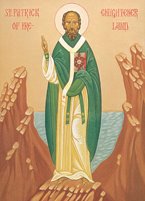
Will the Real St. Patrick Please Stand Up?


Before his career as a plump leprechaun posing for greeting cards, Saint Patrick was a skinny slave boy who became a preacher of the gospel. Much of what we know of him comes from his Confession, a short treatise about his life - and a defense of his orthodoxy to the church higher-ups.

Patrick was born in Britain in the fifth century, but was captured and taken as a slave to neighboring Ireland. At the time, Ireland was known for its cruelty. He prayed, up to 100 times a day, that God would rescue him. Through some remarkable events, Patrick was able to escape back to Britain. Needless to say, he had no plans to return to Ireland!

However, his plans changed. One night he had a dream in which a Irish people pleaded with him: "We appeal to you, holy servant boy, to come and walk among us." Later, he was told in the night: "He who gave his life for you, it is he who speaks with you." With these and other visions, Patrick was persuaded to return to Ireland in order to win them to the Savior. According to Irish annals, Patrick arrived in the year 431.

In spite of his many dreams, Patrick was deeply committed to the Scriptures. His Confession brims with references to the Bible, and in particular Jesus' Great Commission.

Ireland was never the same. Instead of cruelty, Ireland became known for its scholarship, as its Christian monks dutifully transcribed the Scriptures and other important texts. (A book published a few years back was titled How the Irish Saved Civilization.) Patrick's missionary zeal was retained in Ireland, though in what we would consider a somewhat "Roman Catholic" way -- I call this "missionary monasticism."

As you celebrate St. Patrick's Day, keep in mind that one day Patrick - instead of Peter - might greet you at the pearly gates. Depending on his theology, he may offer you a glass of wine - or perhaps a green beer.

Wednesday, March 15, 2006

Sunlight and Spires


One of my favorite sites in Manhattan is St. Patrick's Cathedral. What a contrast to see this monument to Medieval piety compete for space on crowded Fifth Avenue. Its spires, intended to direct the mind to the God of heaven, seem to instead point no higher than the corporate creation that looms over it.

That corporate building (does anyone know its name?) looks like it was intended to be more functional than beautiful. However, on a bright day the sunlight and blue skies are reflected in its windows, a renewed testimony to the God who created those heavens - even if unintentional.

Just as that cathedral is a monument to reverent worship, we can and must glorify God through public adoration and praise. Yet even if our life seems dominated by the daily routines of work or business, we can find ways to reflect God's glory. Hopefully we can point others to him in the process. It might even happen unintentionally!

Monday, March 13, 2006

Jonathan and Janet

Having just taught a church history class on Jonathan Edwards, one of America's greatest intellects (and preacher during the Great Awakening), I took special interest in this news item:

Via Christianity Today:
  • Presbyterian Church (USA) minister Janet Edwards says her performing the marriage of a lesbian couple is an example of walking in the footsteps of her famous sixth-great grandfather, Jonathan Edwards. After all, she told the Pittsburgh Tribune-Review, he ministered to Native Americans, calling them virtuous when they were considered by the culture to be savages. ""I would say his acceptance of the Mohicans of the time is similar to my inclusion of gay-lesbian-bisexual-transgendered people now," she said.

Hmm.

Actually, Edwards taught quite frequently and vehemently that no one is virtuous on their own, whether Mohican, American, or Martian. It's not without reason that his most famous sermon is entitled "Sinners in the Hands of an Angry God." But whether Jonathan Edwards would single out the GLBT crowd more than others, I leave to others to decide.

Here is one of Edwards' earliest journal entries:

"Holiness is a most beautiful and lovely thing. We drink in strange notions of holiness from our childhood, as if it were a melancholy, morose, sour, and unpleasant thing; but there is nothing in it but what is sweet and ravishingly lovely."

So true. 298 years after Edwards' death, we are still trying to find something in religion to excite us, to move us ... other than holiness. We are still finding causes to celebrate, or to fight for, other than holiness.