Saturday, March 18, 2006

Another Trip to St. Patrick's Cathedral

Browsing pictures of St. Patrick's Cathedral the other day, I found this aerial view. Notice that the cathedral has been designed in the shape of the cross, with the sign of the cross mediating between heaven and earth.

If we are to be spared the punishment of God, the cross of Jesus Christ must stand between us and him. That's at the heart of the gospel. The cross is our shield, in the sense that our faith in Jesus' death for our sins protects us from the eternal consequences of unbelief and disobedience.

The cross is more than protection, however. Faith in Jesus Christ brings not only forgiveness but a restored relationship with God, access to God. We can bring our cares, worries, doubts, and fears to him knowing that he cares for us as our children. The cross is not only a shield, but a bridge.


I love you, O Lord, my strength!
The Lord is my rock and my fortress and my deliverer,
my God, my rock, in whom I take refuge,
my shield and the horn of my salvation, my stronghold.
I call upon the Lord, who is worthy to be praised,
and I am saved from my enemies.

- Psalm 18:1-3

Thursday, March 16, 2006

Will the Real St. Patrick Please Stand Up?


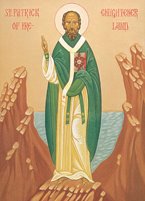
Before his career as a plump leprechaun posing for greeting cards, Saint Patrick was a skinny slave boy who became a preacher of the gospel. Much of what we know of him comes from his Confession, a short treatise about his life - and a defense of his orthodoxy to the church higher-ups.

Patrick was born in Britain in the fifth century, but was captured and taken as a slave to neighboring Ireland. At the time, Ireland was known for its cruelty. He prayed, up to 100 times a day, that God would rescue him. Through some remarkable events, Patrick was able to escape back to Britain. Needless to say, he had no plans to return to Ireland!

However, his plans changed. One night he had a dream in which a Irish people pleaded with him: "We appeal to you, holy servant boy, to come and walk among us." Later, he was told in the night: "He who gave his life for you, it is he who speaks with you." With these and other visions, Patrick was persuaded to return to Ireland in order to win them to the Savior. According to Irish annals, Patrick arrived in the year 431.

In spite of his many dreams, Patrick was deeply committed to the Scriptures. His Confession brims with references to the Bible, and in particular Jesus' Great Commission.

Ireland was never the same. Instead of cruelty, Ireland became known for its scholarship, as its Christian monks dutifully transcribed the Scriptures and other important texts. (A book published a few years back was titled How the Irish Saved Civilization.) Patrick's missionary zeal was retained in Ireland, though in what we would consider a somewhat "Roman Catholic" way -- I call this "missionary monasticism."

As you celebrate St. Patrick's Day, keep in mind that one day Patrick - instead of Peter - might greet you at the pearly gates. Depending on his theology, he may offer you a glass of wine - or perhaps a green beer.

Wednesday, March 15, 2006

Sunlight and Spires


One of my favorite sites in Manhattan is St. Patrick's Cathedral. What a contrast to see this monument to Medieval piety compete for space on crowded Fifth Avenue. Its spires, intended to direct the mind to the God of heaven, seem to instead point no higher than the corporate creation that looms over it.

That corporate building (does anyone know its name?) looks like it was intended to be more functional than beautiful. However, on a bright day the sunlight and blue skies are reflected in its windows, a renewed testimony to the God who created those heavens - even if unintentional.

Just as that cathedral is a monument to reverent worship, we can and must glorify God through public adoration and praise. Yet even if our life seems dominated by the daily routines of work or business, we can find ways to reflect God's glory. Hopefully we can point others to him in the process. It might even happen unintentionally!

Monday, March 13, 2006

Jonathan and Janet

Having just taught a church history class on Jonathan Edwards, one of America's greatest intellects (and preacher during the Great Awakening), I took special interest in this news item:

Via Christianity Today:
  • Presbyterian Church (USA) minister Janet Edwards says her performing the marriage of a lesbian couple is an example of walking in the footsteps of her famous sixth-great grandfather, Jonathan Edwards. After all, she told the Pittsburgh Tribune-Review, he ministered to Native Americans, calling them virtuous when they were considered by the culture to be savages. ""I would say his acceptance of the Mohicans of the time is similar to my inclusion of gay-lesbian-bisexual-transgendered people now," she said.

Hmm.

Actually, Edwards taught quite frequently and vehemently that no one is virtuous on their own, whether Mohican, American, or Martian. It's not without reason that his most famous sermon is entitled "Sinners in the Hands of an Angry God." But whether Jonathan Edwards would single out the GLBT crowd more than others, I leave to others to decide.

Here is one of Edwards' earliest journal entries:

"Holiness is a most beautiful and lovely thing. We drink in strange notions of holiness from our childhood, as if it were a melancholy, morose, sour, and unpleasant thing; but there is nothing in it but what is sweet and ravishingly lovely."

So true. 298 years after Edwards' death, we are still trying to find something in religion to excite us, to move us ... other than holiness. We are still finding causes to celebrate, or to fight for, other than holiness.

Saturday, March 11, 2006

How to Never Be Shaken


One of the shortest Bible studies I ever attended was led by my former boss, Dale Lowrimore. He simply said, "How would you like to never be shaken?" And then he read this short psalm:

Psalm 15

A psalm of David.
1. Lord, who may dwell in Your sanctuary? Who may live on Your holy hill?
2. He whose walk is blameless and who does what is righteous, and who speaks the truth from his heart
3. and has no slander on his tongue, and who does his neighbour no wrong and casts no slur on his fellow man,
4. who despises a vile man, but honours those who fear the Lord, who keeps his oath even when it hurts,
5. who lends his money without usury and does not accept a bribe against the innocent.

He who does these things will never be shaken.

I think about that brief Bible study whenever I read this psalm.

Notice that one of the ways we are "never shaken" is to "keep our oath even when it hurts." For me, it is so easy to change plans - even simple ones - because "something better comes up." Yet the simple act of keeping our promise, even when we find it to be difficult or simply inconvenient, works in us the kind of character that will give us stability over the long haul.

Now look at what I've done. This short devotional is already longer than Dale's one-sentence reflection ont his passage. So let me simply encourage you to re-read this psalm and consider his question: "How would you like to never be shaken?"


NOTE: Dale Lowrimore is currently serving as a police chaplain in San Diego. You can check out his ministry info by clicking here.

Thursday, March 09, 2006

Three Ways to Ask Why


Why, God?

Is this a proper question for us to ask? Depends on how we ask it!

#1. Why me, God? Sometimes we only ask "why?" when something hits close to home. If we had read about the same disaster or difficulty in the newspaper, we might have gone on with our day without a crisis of faith. Glad it's them, not me! If it had happened to our neighbor or friend, we might have been sad...but not too shaken. We love ourselves far more than our neighbors; whenever we ask why it does us well to search our heart and repent of this.

#2. Why God with a fist. When we scowl at God, raise our fist, and ask why, we sin against God. We also sin against our own well being, for we close ourselves off to the answer God might give.

#3. Why God, with humility. When our why is joined with humility, I believe it is an expression of faith. Humility means that we are open to God's answer, or to no answer at all. We entrust ourselves to God in spite of the confusion, but also express ourselves to God. We know that as our heavenly Father he will not be surprised or angered by our question.

Related to the why question is another question seen frequently in the Bible:

How long, O Lord?
Will you forget me forever?
How long will you hide your face from me?
(Psalm 13:1)

To ask how long implies that we know that God will ultimately deliver us, that his intention for us is good. We may be troubled by the difficulties God allows - but we know it is not forever. We know his good purposes will win out.

Lift up your questions to God, but not your fists.

Tuesday, March 07, 2006

Worship: What's it All About?


It wasn't long ago that I wondered, "Where has all the good Christian music gone?" Afterward, turning on the local Christian radio station, I heard a song whose lyrics were, "It's all about love, love, love, love, love, love, love."

It is?

As our worship vocabulary increases, our heart for worship expands as well. If our only words for worship are "love" and "awesome," our growth in worship will be stunted. There is a need for originality in worship music, which should be creative rather than packaged.

Our worship vocabulary includes several forms of expression: words, music, ideas. Thus, our worship vocabulary expands by gaining new words, new or improved forms of musical expression, and even new theological concepts.

My favorite contemporary worship songwriter is Matt Redman. While not above reminding us that God is awesome, his songs consistently remind us of much more. A musical friend told me that he likes to use Redman's "Blessed Be the Name of the Lord" in worship because there aren't many contemporary songs that put words like these in worshipers' mouths:

"Though there is pain in the offering, blessed be Your name!"

and, simply,

"He gives and takes away, he gives and takes away...my heart will choose to say, blessed be the name of the Lord."

These words, taken from one of the oldest books in the Bible, shouldn't seem new. But in a Christian subculture that's "all about love, love, love, love, love," it rings original. Oh, how we need the Lord to truly be our worship leader, that we might be led to streams of living - rather than stagnant - water! Revive us, O Lord.

Monday, March 06, 2006

Back to Reality


Reality TV, that is.

Tonight my favorite “reality” show, The Apprentice, airs. Though all seasons are not created equal – it’s taken some hammering in the ratings and time slots - I like this show’s leadership, teamwork, and marketing themes. To different degrees, these themes each relate to pastoral ministry and evangelism.

Of course, the show is also about money. The Bible has a lot to say about money, not to mention leadership, teamwork, and… well, maybe marketing too. (Perhaps my marketing friends can help me out on this one.)

The Bible speaks both positively and negatively how money is earned and used. Just today, I happened to read Psalm 10. This psalm describes two lies wealthy people sometimes tell themselves:

Lie #1: There is no God, and therefore no judgment to worry about.

In the pride of his face, the wicked does not seek [God]; All his thoughts are, “There is no God.” (Psalm 10:4)

Lie #2: There is no end to the possibilities.
He says in his heart, “I shall not be moved; Throughout all generations I shall not meet adversity.” (10:6)

Part of the fun of The Apprentice is to figure out what drives people to compete and win in the business world. Certainly there are healthy motives, approved by God. But that doesn’t mean that unhealthy motives don’t “work” for some people. In fact, it might be that Christians are sometimes less successful because reality slows them down. They don’t consider certain options because they believe in God and his eventual judgment - while their non-Christian competition forges ahead no matter what the cost may be to their soul.

However, there is a God. There will be an end to the possibilities. And then those who have pursued financial success without considering this will have to come “back to reality.”

Saturday, March 04, 2006

I Praise the Lord, My Soul to Keep


"O LORD, our Lord, how majestic is your name in all the earth! You have set your glory above the heavens. Out of the mouth of babes and infants, you have established strength because of your foes, to still the enemy and the avenger." (Psalm 8:1-2)


Upon praising God, the psalmist claims that somehow the utterances of children both "establish strength" and "still the enemy." Just what does this mean?

This Scripture declares that God's children, though not as strong as their enemies, win the ear of God and the favor of God. I am not sure whether literal children (babes and infants) are in view, or whether this is speaking of others in humble circumstances.

I am also uncertain what exactly proceeds from the "mouth" of babes and infants that so honors God. It would seem the most likely answer is praise. God wants his foes silenced--he doesn't care for what they have to say. However, he loves to hear the praise offered by humble children.

One more thought: This passage says that God stills "the enemy and the avenger." An enemy is someone who unjustly seeks our harm, yet an avenger in biblical times was someone who justly sought repayment for harm done to them. If I understand this passage correctly, it's the gospel in brief: God not only delivers us from harm that we don't deserve, but most importantly from the sentence of death we do deserve.

That is indeed reason to give him praise!

As we enjoy "free time" this weekend, I hope we will remember to join the psalmist in considering the majestic - and kind - works of the Lord.

Thursday, March 02, 2006

People in Common


During the busy work day, it's as if we are all occupied by our individual sections of a giant puzzle. We don't often get a break to observe the "bigger picture." This applies to businessmen, mothers, and yes, even pastors. Yet we also long to connect with others, to consider how we "fit in," and explore the larger meaning behind it all.

But how do we do this? How do we find ways of bridging our island with others'?

Recently, a charming old woman who reads this blog asked me to comment on American Idol. I think this fits right into the topic at hand. I would suggest that this show is so popular, at least in part, because Americans feel this need to connect. Celebrities provide "people in common" to discuss or gossip about, and TV shows likewise provide "stories in common" to share.

However, if leisure time is used only for escape, and not also for more meaningful exploration, our society is certainly watered down. It's much easier to connect with people by discussing the latest Idol, Apprentice, or Survivor - and I don't think this is wrong in itself - but we benefit most when we connect on a higher level. For example, if we are able to share not only celebrities and songs, but also our ideas and our faith.

Here's an old song from the Bible that helped connect people together for millennia. I haven't heard anyone cover this song on Idol (at least not yet) but it's a good one.

O Lord, our Lord, how majestic is your name in all the earth!
You have set your glory above the heavens.

Out of the mouth of babes and infants, you have established strength because of your foes,
to still the enemy and the avenger.


When I look at your heavens, the work of your fingers,

the moon and the stars, which you have set in place,

what is man that you are mindful of him,

and the son of man, that you care for him?
(Psalm 8:1-4)

In our free time we determine, whether intentionally or not, what we will have in common. More profoundly, we determine whom we will have in common.

Wednesday, March 01, 2006

O Death, Where Art Thou?


Death so often seems distant. So many die each day, but not nearby. Even if we hear about death on television, it so often doesn’t seem near to us. Even so, we move on...and away.

Recently, due to the loss experienced by a family in our church, death drew a little closer. The busyness of this world and the cares of this world then came into clearer perspective.

Today I noticed some were frustrated because our long funeral procession caused them unexpected delay. They couldn’t go through their green light because the hearse, followed by about 20 other vehicles, was slowly but surely winding its way through the streets. How symbolic! The reality of death, which should make us compassionate as well as sober-minded, is often a mere distraction.

Of course, it seems a distraction only when it is far away. When it comes near us, should we have the luxury of seeing its approach, all other concerns to take a distant second, third, or millionth place.

This is why the wisest man in Israel once said:
“It is better to go to the house of mourning than to go to the house of feasting, for this is the end of all manking, and the living will take it to heart.” (Ecclesiastes 7)

And our Lord himself said, “Blessed are those who mourn, for they shall be comforted” (Matthew 5).

Law and Gospel, the Update


Thanks to those who prayed for my friend John Malki. Although he will not immediately know the results of his bar exam, he feels he did pretty well. In fact, in true Malki style, he's a bit frustrated that the bar wasn't set higher.